
HUD VELOCITY & SUPERSTRING WARP (SW) NOTATION
Table of Contents
I. Base Constant: The Speed of Light
II.Exponent Notation in the HUD
III. Superstring Warp Factor (SWn)
IV. Simulation Distance Scaling
V. Superstring Burn (Acceleration Curve)
a. LOW-END SWn EXAMPLE (Warp One Starting Spaceship)
b. HIGH-END SWn EXAMPLE (Arcus Ascendant)
c. SOLAR SYSTEM SCALE (For Player Context)
d. TRAVERSAL TIME AT MAXIMUM SWn (Arcus Ascendant)
e. Why Crossing the Solar System Takes ~5 Minutes (Even at Maximum SW⁵)
i. Celestial Bodies Are Moving Away from You
ii. Superstring Burns Require Charge Time
iii. Double Burn Maneuvers Add Delay
iv. The HUD Shows Instantaneous Velocity, Not Mission Time, HUD readout (e.g., 1300⁵)
VI. Standard and Superstring Transition (The ontological perspectives)
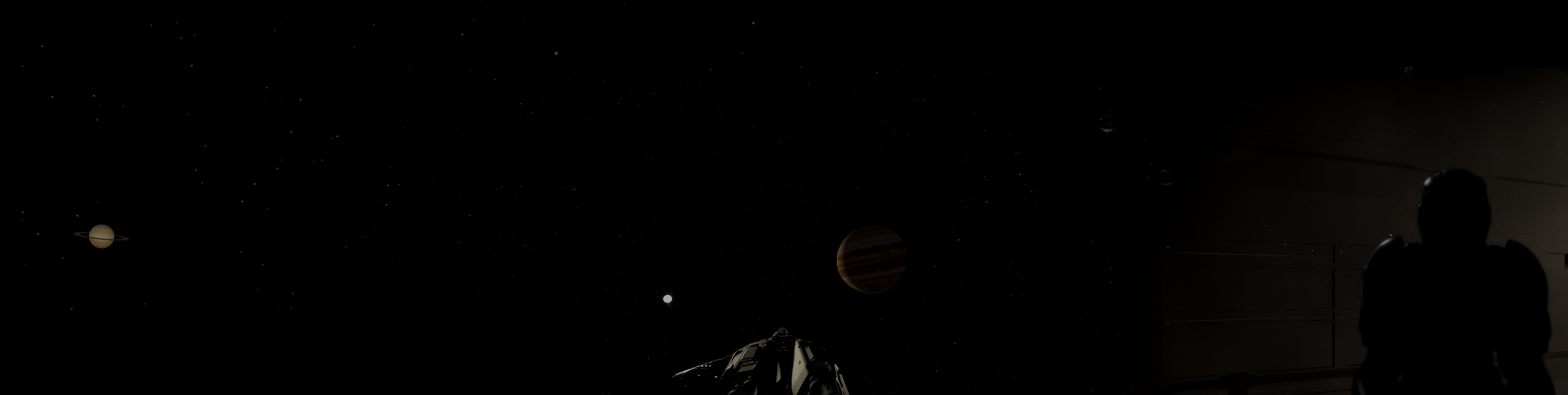
Vibrate through the solar system at consistent scale
I
Base Constant: The Speed of Light
Warp Ancestor defines the speed of light as the fundamental unit of motion:
1c = 299,792.458 km/s
This is the anchor for all warp‑era velocity calculations.
II
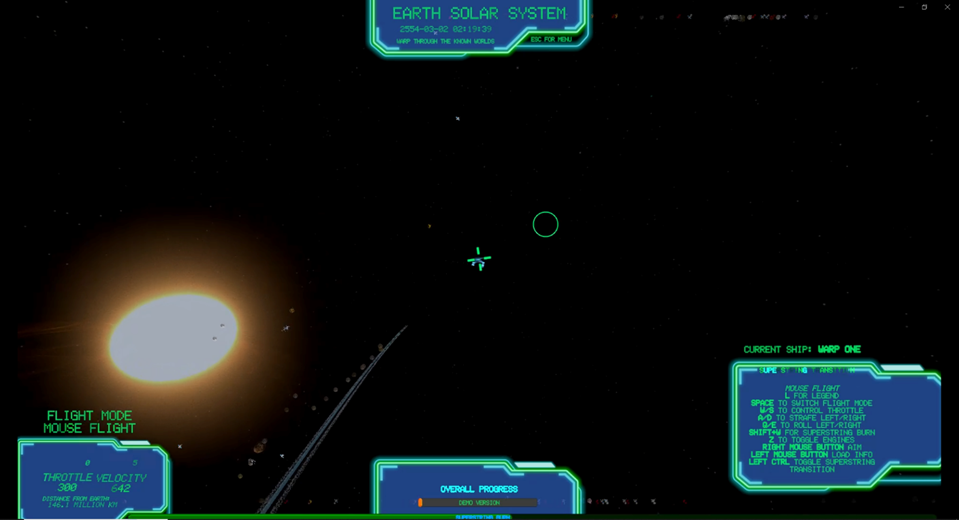
Exponent Notation in the HUD
Warp Ancestor uses exponent notation for:
velocity readout
throttle readout
But:
The exponent (n) is a superstring warp stage, not a mathematical power.
1n = 1c = 299,792.458 km/s
This preserves dramatic notation without implying impossible speeds.
III
Superstring Warp Factor (SWn)
The in-game Superstring Warp factor multiplies c directly:
1 SWn = 1 × 1n × 1c
This is the raw warp factor before scaling to the simulation grid.
IV
Simulation Distance Scaling
Warp Ancestor uses a physically grounded scale:
7.462686 × 10^(-5) AU = 11.5 km per Unity unit
So:
1 SWn = 1 / 11.5 km × 1n × 1c
1 SWn = 0.0869 km × 1n × 1c
This ensures that warp speeds remain coherent with the simulation’s spatial scale.
v
Superstring Burns (Acceleration Curve)
Superstring burns apply controlled multipliers via an acceleration curve.
This is how the HUD reaches values like:
• 36⁵
• 1300⁵
…without implying literal exponentiation.
ECOSYSTEM
a. LOW END SWn EXAMPLE (Warp One Starting Spaceship)
Base engine velocity:
36 km/s
Scaled velocity:
36 × 0.0869 = 3.1284 km/s
Superstring stage 5:
5n = 5 × 299,792.458 = 1,498,962.29 km/s
Final velocity:
36^5 = 3.1284 × 1,498,962.29
36^5 = 4,689,353.628 km/s
This is the low-end warp velocity for the base ship.

This is the high-end warp velocity for the Arcus Ascendant.
Base engine velocity:
1300 km/s
Scaled velocity:
1300 × 0.0869 = 112.97 km/s
Superstring stage 5:
5n = 1,498,962.29 km/s
Final velocity:
1300^5 = 112.97 × 1,498,962.29
1300^5 = 169,337,769.9013 km/s
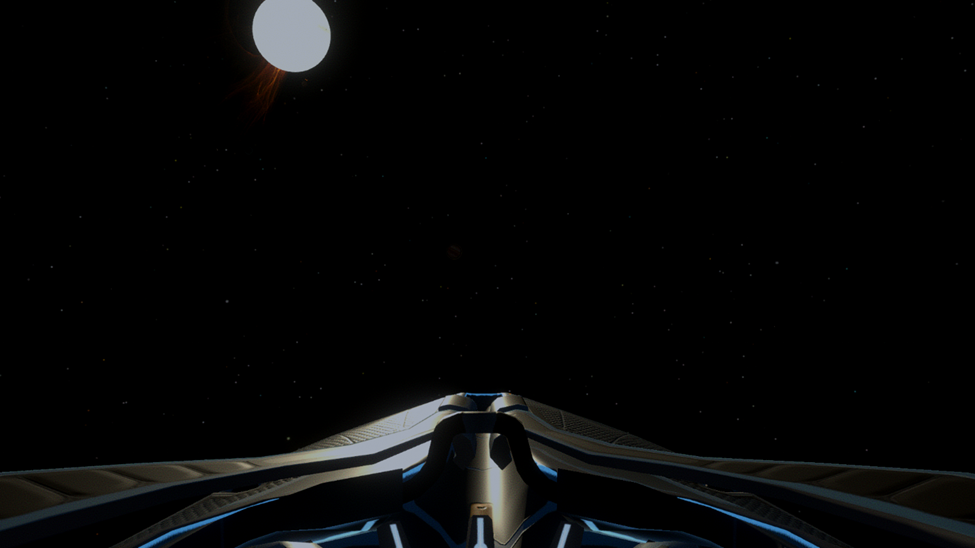
B. HIGH-END SWn EXAMPLE (Arcus Ascendant)
c. SOLAR SYSTEM SCALE (For Player Context)
Neptune’s average distance from the Sun:
4.5 billion km
Pluto’s average distance from the Sun:
5.9 billion km
Opposite side alignment:
4.5 + 5.9 = 10.4 billion km
This is the maximum meaningful traversal distance inside the Solar System.
d. TRAVERSAL TIME AT MAXIMUM SWn (Arcus Ascendant)
At:
1300^5=169,337,769.9013 km/s
Time to cross:
10.4 billion km
t = 10,400,000,000 / 169,337,769.9013
t ≈ 61.41 seconds
⟶ The fastest ship in Warp Ancestor can cross the entire Solar System in ~61 seconds, increased by burn gauge time and recharge times as well as course correction and realignment out of warp.
traversal
Why Crossing the Solar System Takes ~5 Minutes (Even at Maximum SW⁵)
Warp Ancestor’s velocity system is grounded in real physics, but the solar system itself is not static.
Every planet, dwarf planet, moon, and Kuiper Belt object is moving at high orbital velocities—often tens of thousands of km/s relative to the player’s trajectory.
Because of this, the traversal time is influenced by more than raw warp speed.
You’re not flying across a map. You’re flying across a moving system.
iii. Double‑Burn Maneuvers Add Delay
To maintain stability at extreme SW⁵ velocities, the fastest ships must occasionally perform the following:
- double burns
- course corrections
- warp‑bubble realignment
- These are micro‑interruptions, but they accumulate over a 10‑billion‑km traversal.
Here’s the clean explanation:
i. Celestial Bodies Are Moving Away from You
Even at superstring stage 5, the ship is chasing targets that are
- orbiting the Sun
- drifting outward
- shifting position during the burn
- moving at high tangential velocities
This means the effective distance is always slightly larger than the static ephemeris value.
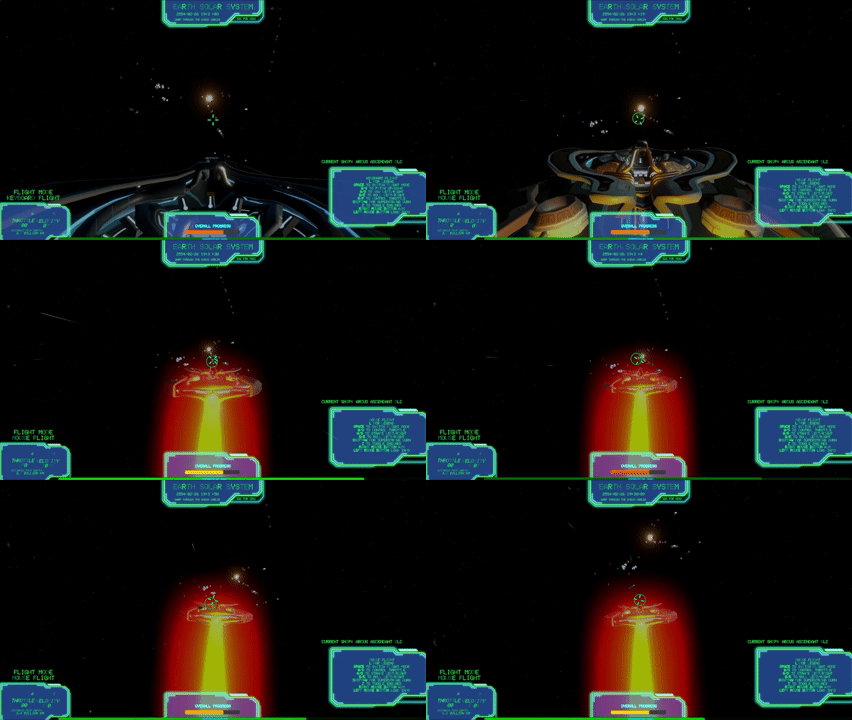
iv. The HUD Shows Instantaneous Velocity, Not Mission Time
The HUD readout (e.g., 1300⁵) shows the following:
- the current warp factor
- the current superstring stage
- the instantaneous velocity
- But mission time includes:
- acceleration
- deceleration
- burn-charging
- orbital drift
- course correction
So the HUD speed and the actual traversal time are not identical.
This is intentional and realistic.
ii. Superstring Burns Require Charge Time
Warp Ancestor uses multi‑stage superstring burns:
- Stage 1 → ignition
- Stage 2 → stabilization
- Stage 3 → resonance
- Stage 4 → compression
- Stage 5 → full superstring alignment
Each burn requires:
- charge time
- stabilization
- cool-down
- realignment
This adds real‑time overhead between bursts of maximum velocity.
VII. Standard and Superstring Transition (The ontological perspectives)
A SIMPLE LEFT CTRL TOGGLE BETWEEN SUPERSTRING TRANSITION MODE AND STANDARD TRANSITION REINFORCES ONE IMPORTANT THING UNDER THE HOOD
STANDARD TRANSITION
(STARTING MODE):
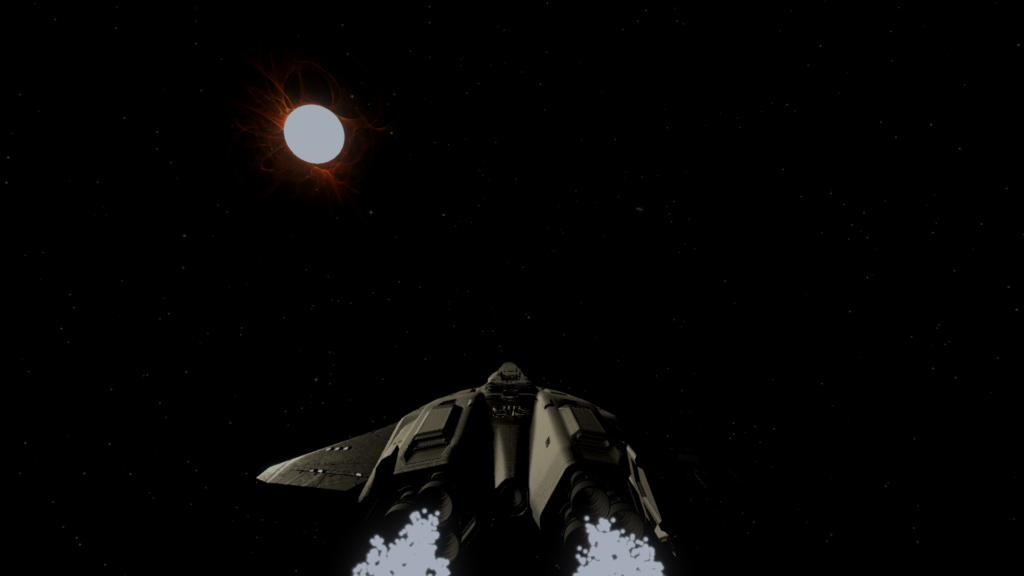
TIGHT CAMERA FOLLOW OF YOUR SHIP. YOUR CONSCIOUSNESS HOVERS JUST OUTSIDE, LIKE THE GUARDIAN ANGEL OF YOUR OWN TRAVERSAL…
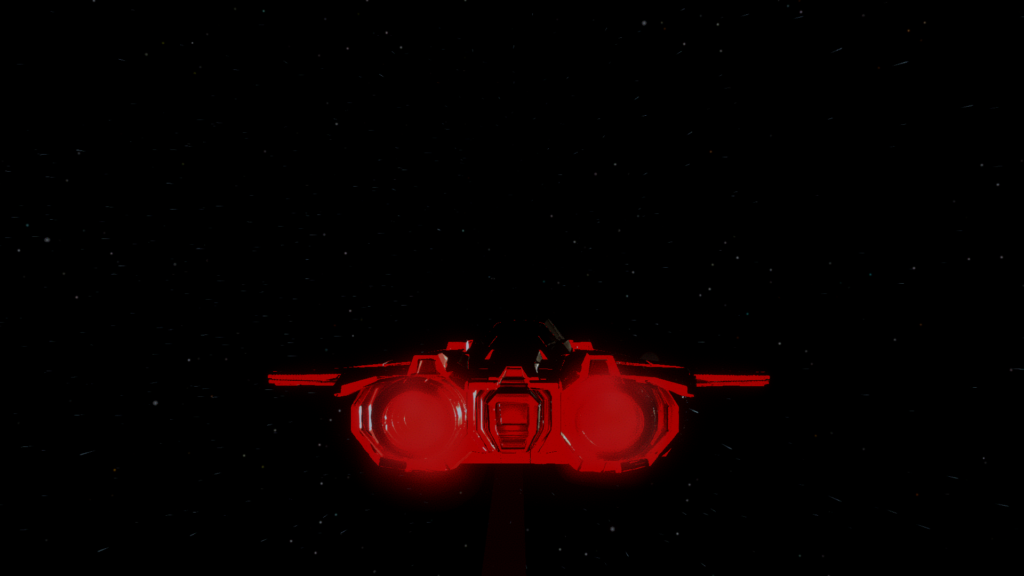
SUPERSTRING TRANSITION
SIGNIFICANTLY REDUCES CAMERA FOLLOW SPEED. YOUR SHIP IS OUTRACING YOUR PERSPECTIVE.
COMBINE WITH MOUSE ZOOM USING THE MOUSE WHEEL TO VIBRATE THROUGH TIME.
Leave a Reply